


Session and Time-of-Day Effects: Trading Across Tokyo, London, and New York
21 ноября 2025
287 views
Level: Intermediate
Core Concept: Liquidity, spreads, volatility, and price behavior across global markets (Forex and index futures) are not static throughout the day. They are structured according to the business hours of the world’s major financial centers. Understanding these daily cycles is crucial for adapting your trading strategy, managing risk, and improving execution accuracy.
Characteristics of the Major Trading Sessions
The 24-hour market cycle can be divided into three primary sessions, each offering a unique profile of liquidity and volatility.

The Asian Session (Tokyo)
- Key Characteristics: This is typically the least volatile session. Trading volumes, outside of Japanese Yen (JPY) pairs, are low. Spreads can be slightly wider than in other sessions due to lower liquidity.
- Typical Price Behavior: Price often forms a narrow consolidation range (a flat range).
- Suitable Strategies: Ideal for breakout strategies (expecting a move out of the range later) or low-frequency range trading.
The European Session (London)
- Key Characteristics: London is the global liquidity hub. Volatility increases sharply, spreads narrow to their minimum, and volumes peak.
- Typical Price Behavior: This session often sets the main trend of the day. The market typically invalidates any false moves made in Asia and initiates a decisive directional move.
- Suitable Strategies: Excellent for trend-following strategies and active day trading.
The American Session (New York)
- Key Characteristics: Volatility remains high, and activity is often driven by the release of key macroeconomic news (NFP, CPI, Fed decisions), causing sharp price spikes.
- Typical Price Behavior: This session can continue the trend set by London or cause a sharp reversal driven by US data or profit-taking by European institutions.
- Suitable Strategies: Intensive day trading and large-volume execution.
The London–New York Overlap: Peak Liquidity and Volatility
The most critical period for the active trader is the four-hour window when the European and American sessions are simultaneously active.
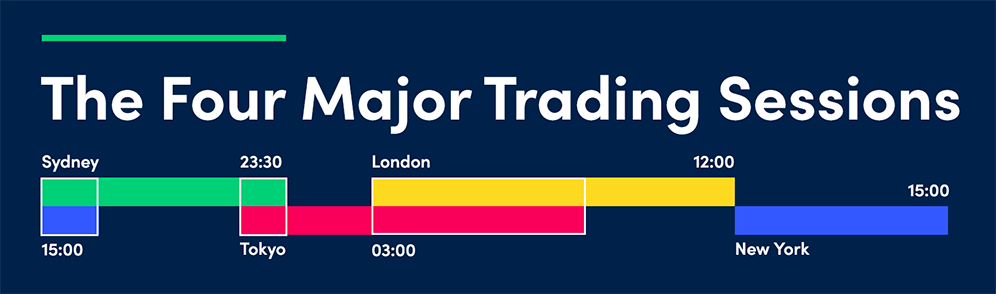
- Peak Volume and Lowest Spreads: Both major financial centers are trading, providing maximum liquidity and the narrowest spreads, which is beneficial for execution quality.
- Peak Volatility: The combination of European traders adjusting or closing their morning positions and American traders entering the market, along with the release of high-priority US economic data, leads to extreme volatility.
- Trading Plan: If you are an active day trader, your best opportunities for movement and reliable execution occur during this four-hour window.
Typical Time-of-Day Price Patterns
The market exhibits predictable «habits» based on the time of day, which traders can incorporate into their analysis.
- The Morning Fakeout: Often occurs during the early hours of the London session. Price may make a sharp false move against the Asian trend to collect stop-losses before starting the true directional move of the day.
- The London Reversal: If the price was contained in a tight range during the Asian session, the London open often results in a breakout and reversal of the preceding move, setting the daily bias.
- The NY Close: The final hours of the New York session are often characterized by profit-taking and hedging position adjustments. This can cause a spike in volatility and movement contrary to the main trend, as large institutions finalize their daily books.
Strategy Adaptation to Your Local Time
Your trading plan must be tailored not just to the market, but to your geographical location and availability.
- Scalping and High-Frequency Trading: These strategies depend on minimal spreads and maximum speed. They should be executed almost exclusively during the London–New York overlap. Trading outside this window increases the risk of wide spreads negating potential profits.
- Breakout Trading: These strategies are often most effective at the London open (breaking the Asian range) and the New York open (breaking the European range).
- Positional Analysis: For determining the global trend and establishing reliable entry points, the most informative candle close is the New York Close (NY Close), as it represents the official closing time of the largest global market.
Time-of-Day Filters in Trading
The conscious use of time-based filters is a powerful tool for risk management and efficiency, regardless of whether you trade manually or algorithmically.
Filter Application
- Filtering Low Liquidity (Asia): If your strategy relies on volatility and tight spreads, use a filter to exclude trading during the off-hours of Europe and the US to avoid false breakouts and increased costs.
- Filtering High Volatility (News): On «red news» days (e.g., NFP), implement a strict filter to prevent entering or adjusting positions 10 minutes before and 20 minutes after the publication. This protects your account from uncontrolled slippage.
- Optimizing the Trading Window: In manual trading, identify your «golden hours» (the London–NY overlap) and concentrate 80% of your trading effort into this specific window. This boosts concentration and improves overall performance efficiency.
Conclusion
Time is not merely a chronological marker; it is a fundamental filter of risk and liquidity. For the successful trader, knowing what to buy or sell must be coupled with knowing when to execute. By actively adapting your strategy to the volatility profiles of the major sessions — from the quiet Asian consolidation to the explosive London–New York overlap — you transform the external structure of the market into a reliable, high-probability element of your internal trading plan.

